Minnesota homeowners who install solar can access incentives from three sources: the federal government, the state of Minnesota, and their electric utility. Each has its own eligibility requirements, its own payout timeline, and its own fine print. Net metering — often grouped with incentives — is technically a billing mechanism rather than a payment, but it has a larger effect on the financial outcome than some of the actual incentives.
All figures below use the same reference system throughout: a 9 kW installation in a Twin Cities suburb, Xcel Energy customer, $27,000 installed cost, south-facing roof in good condition, cash purchase.
The federal solar tax credit
A dollar-for-dollar credit against federal income taxes. Not a deduction, not a rebate — a direct reduction of what the homeowner owes. On a $32,000 system, it’s $9,600. The math is straightforward.
The credit applies in the year the system is placed in service — the year it’s connected and generating electricity. A system installed in December 2025 earns the 2025 credit. January 2026 earns the 2026 credit. This matters near year end.
The 30% rate holds through 2032, then drops to 26% in 2033 and 22% in 2034 before expiring for residential installations. Battery storage installed at the same time qualifies for the same credit.
The credit only applies against taxes actually owed. A homeowner who owes $5,000 in federal taxes uses $5,000 in year one — the remaining $3,100 carries forward. A homeowner with consistently low federal tax liability should model the multi-year picture before counting on immediate full recovery.
The federal tax credit is a tax matter. Confirm your specific liability and carry-forward situation with a tax advisor before using the ITC in financial planning.
Xcel Energy Solar*Rewards
A production-based payment for every kWh the system produces — regardless of whether that electricity is used in the home or sent to the grid. At approximately $0.08/kWh, a 9 kW system producing 10,500 kWh per year earns roughly $850 annually for 10 years.
The per-kWh rate is locked at enrollment and doesn’t change over the contract. A homeowner enrolling at $0.08/kWh receives exactly that in year ten. This creates predictable revenue, but it means the rate at enrollment matters — and rates change between program periods.
This is different from net metering. Solar*Rewards pays for total production. Net metering credits excess electricity sent to the grid. Both apply simultaneously and appear separately on the Xcel bill.
Solar*Rewards has annual budget allocations and enrollment periods. Program availability is not guaranteed — confirm current availability with Xcel or your installer before including this incentive in financial projections. Some service areas have experienced waitlists.
Solar*Rewards payments are taxable income. Xcel issues a 1099. A homeowner in the 22% federal bracket and Minnesota’s 5.35% state rate nets approximately $620 per year after taxes, not $850. Factor the after-tax figure into projections.
Solar*Rewards is available only to Xcel Energy customers. Homeowners served by municipal utilities or electric cooperatives should contact their utility directly — some cooperatives offer comparable programs, many do not.
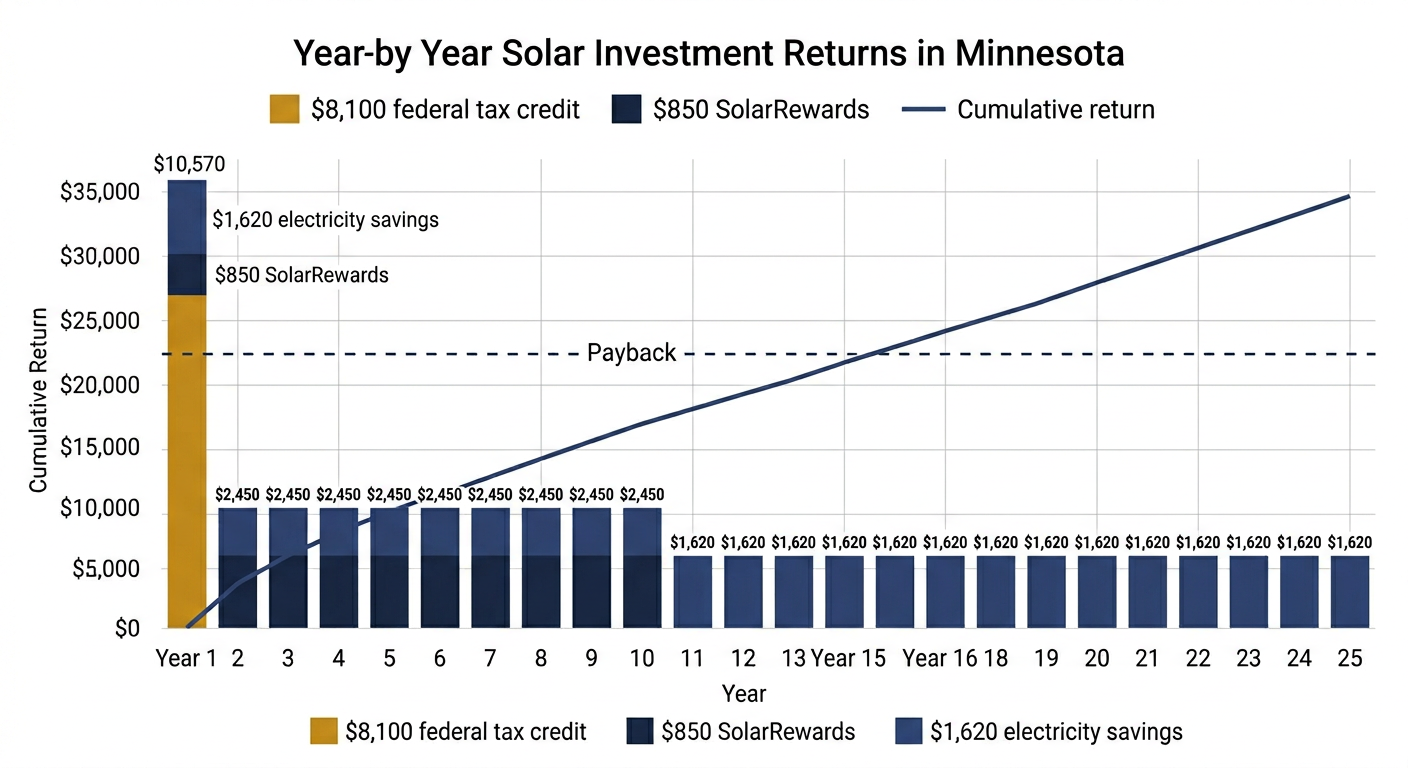
Annual returns: Year 1 ($10,570 including tax credit) → Years 2–10 (~$2,450/yr with Solar*Rewards) → Years 11–25 (~$1,620/yr electricity savings only). System recovers full cost around year 8.
Minnesota sales tax exemption
Solar energy equipment is exempt from Minnesota’s 6.875% state sales tax. On a $27,000 system, that’s approximately $1,850 that simply doesn’t appear on the invoice. The installer handles the paperwork (Form ST3) — the homeowner does nothing.
Covers panels, inverters, racking, and wiring directly associated with solar generation. Does not cover structural roof improvements that aren’t part of the solar system itself.
One thing to confirm: that the installation quote does not include sales tax on solar equipment. If it does, ask why.
Minnesota property tax exemption
Minnesota law prevents solar-added home value from being included in property tax assessments. A system adding $25,000–$30,000 to home value would otherwise mean $300–$360 per year in additional property taxes at a typical Minnesota effective rate of 1.2%. Over 25 years, that’s $7,500–$9,000 in avoided taxes.
The exemption applies automatically under Minnesota statute for standard residential installations. No application, no income qualification, no action from the homeowner.
Net metering
Net metering is not an incentive — it’s a billing mechanism. But it has a larger effect on the long-term financial picture than either the sales tax or property tax exemptions, and the confusion between net metering and Solar*Rewards causes real problems in planning.
When the system produces more electricity than the household is using at a given moment, the surplus flows to the grid and Xcel credits the account. For Xcel residential customers, the credit rate is approximately $0.11–$0.13 per kWh. These credits offset electricity drawn from the grid at other times — evenings, winter months, cloudy periods.
Net metering credits are not cash. Surplus credits accumulated beyond annual usage are retired by Xcel at year end — not paid out. This is why system sizing matters: a significantly oversized system generates credits the homeowner will never use.
The fixed monthly utility customer charge — approximately $11–$12 per month for Xcel residential accounts — applies regardless of solar production. Over a year, that’s $132–$144 that solar does not eliminate. Most homeowners accept this once they know it. Discovering it after installation feels like a surprise it shouldn’t be.
Minnesota’s net metering law applies to all utilities in the state for systems under 40 kW. The credit rate varies by utility — cooperative and municipal utility customers should confirm their specific rate before finalizing system sizing.
Other programs worth knowing about
Made in Minnesota: Offers additional per-kWh payments for systems using Minnesota-manufactured components. When funded, it’s meaningful. Honest assessment: the program has experienced repeated funding gaps and inconsistent availability. Do not include it in financial projections unless your installer can confirm current enrollment is open at the time of the project.
C-PACE financing: Minnesota’s Property-Assessed Clean Energy program applies to commercial properties only. There is no active residential PACE financing program in Minnesota. If you’ve encountered PACE as a residential solar option, it does not apply in this state.
Community solar: An option for homeowners who can’t install rooftop panels — rental situations, shaded roofs, HOA restrictions. Community solar has different economics and different trade-offs. It’s not addressed here because mixing rooftop and community solar creates more confusion than clarity.
What the full incentive stack adds up to
All incentives together, on the reference system: 9 kW, Twin Cities suburb, Xcel Energy, $27,000 installed, cash purchase.
| Incentive | Value | When it arrives | Guaranteed? |
|---|---|---|---|
| Federal tax credit (30%) | $8,100 | Year-1 tax filing | Yes, through 2032 |
| Xcel Solar*Rewards (10 yr) | ~$8,500 total | ~$850/yr for 10 years | Rate locked; enrollment not guaranteed |
| Sales tax exemption | ~$1,850 | At purchase | Yes, current MN law |
| Property tax exemption (25 yr) | ~$7,500–$9,000 | ~$330/yr, ongoing | Yes, current MN law |
| Electricity savings (25 yr) | ~$59,000 | ~$1,620/yr, growing 3%/yr | Estimated; depends on usage and rates |
| Net financial benefit (25 yr) | ~$47,000 | After $27,000 system cost + ~$2,000 inverter replacement | |
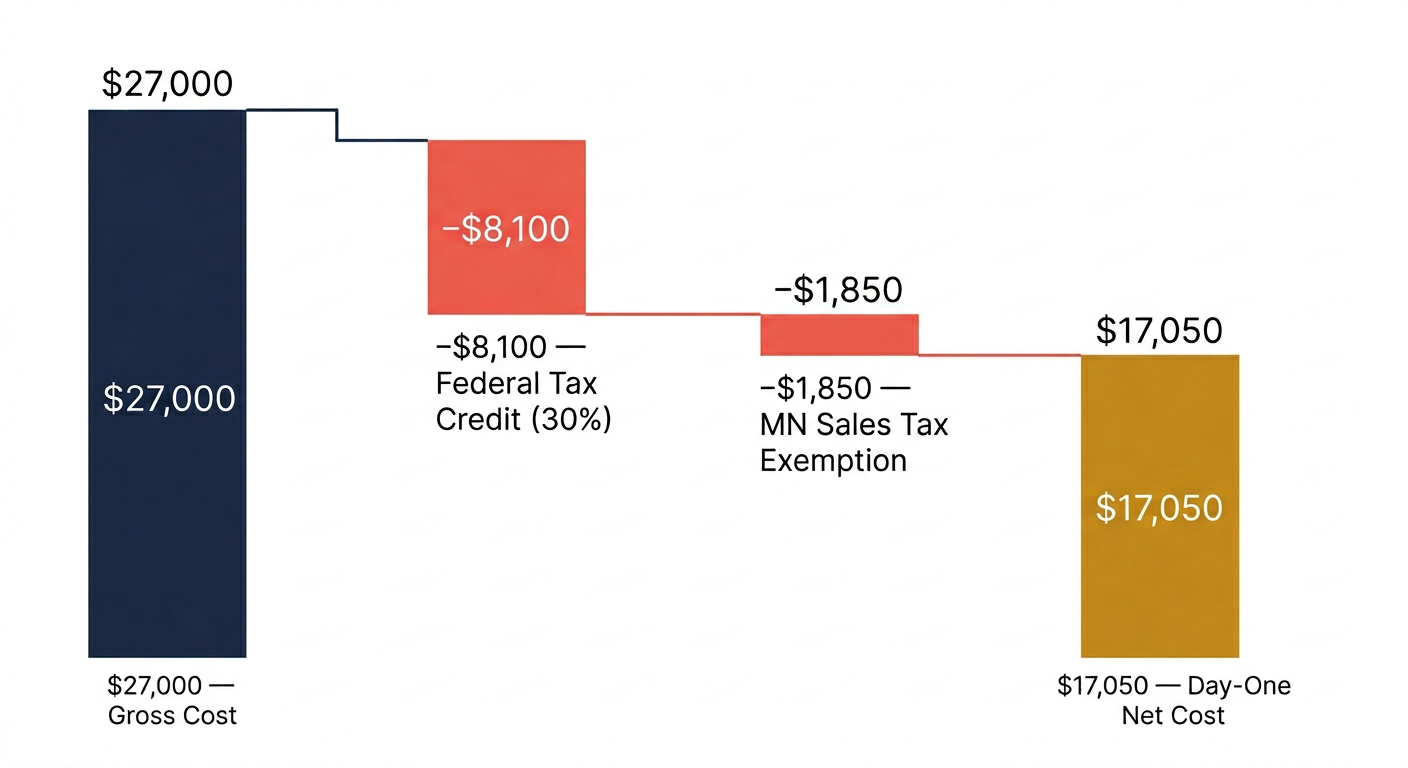
From $27,000 gross cost: −$8,100 federal tax credit → −$1,850 sales tax exemption → $17,050 effective net cost before Solar*Rewards and electricity savings.
The first-year picture: the homeowner pays $27,000 out of pocket. In year one, the $8,100 federal tax credit comes back through the tax filing. Solar*Rewards pays approximately $850. Electricity savings total approximately $1,620. That’s $10,570 returned in year one, leaving approximately $16,400 still to recover.
In years two through ten, Solar*Rewards and electricity savings together return approximately $2,450 per year. Around year eight, cumulative returns equal the original investment. After year ten, Solar*Rewards ends but electricity savings continue — at an escalating rate as Xcel rates rise.
The fine print, collected in one place
Every incentive has at least one catch. These are all of them.
Federal tax credit requires sufficient federal tax liability. Unused credit carries forward, not paid in cash.
Solar*Rewards payments are taxable income. After-tax value is roughly 27% lower than the headline figure.
Solar*Rewards enrollment is not guaranteed. Confirm program availability before including in projections.
Net metering credits don’t convert to cash. Surplus credits at year end are retired by Xcel.
Made in Minnesota program has funding gaps. Don’t include unless confirmed available at time of install.
Monthly Xcel customer charge (~$11–$12) applies regardless of solar production. It doesn’t go away.
Not sure if your home is a good solar candidate?
The incentives are only worth knowing if your home actually qualifies. Answer 7 questions and find out.
Take the Free Self-Assessment →Frequently Asked Questions
Yes — the 30% credit is based on the total installed system cost, regardless of how it’s financed. A homeowner who takes a solar loan for $27,000 still receives the $8,100 credit. However, many solar loans require the homeowner to apply the tax credit to the loan principal within the first year or face a balloon payment or rate adjustment. Read the loan terms carefully before signing.
Solar*Rewards pays for every kWh the system produces, regardless of whether that electricity is used in the home or sent to the grid. Net metering credits only the excess electricity sent to the grid, at the retail rate. Both apply simultaneously. A homeowner enrolled in Solar*Rewards will see both a Solar*Rewards line item (production payment) and net metering credits on their Xcel bill. They are separate programs that operate independently.
The Solar*Rewards contract can typically be transferred to the new owner. The rate and remaining contract term transfer with the system. Both parties should confirm the transfer process with Xcel during the sale. A new owner who does not want to continue the contract has options, but exiting early may have consequences — confirm terms before assuming transferability is simple.
The property tax exemption prevents the county from assessing additional property taxes on the solar-added home value — but it doesn’t affect what a buyer is willing to pay for the home. Studies consistently show that owned solar systems add to resale value. The exemption means the homeowner captures the full resale value benefit without the tax penalty. Leased systems complicate resale because the buyer must assume the lease — owned systems avoid this entirely.
The unused portion carries forward to subsequent tax years until fully used. There is no expiration on the carry-forward for homeowners who installed in 2024 or 2025 — the credit remains available until fully applied. The credit does not convert to a refund; it only offsets taxes owed. A retiree with very low federal tax liability may take five or more years to fully use a large credit. This doesn’t eliminate the credit, but it changes the cash flow timeline significantly.