Every figure on this page is based on current Minnesota data and typical Xcel Energy rates. The reference system throughout: 9 kW, $27,000 installed, Twin Cities suburb, Xcel customer, cash purchase.
Does solar actually work in Minnesota?
Minnesota averages 4.0 to 4.5 peak sun hours per day — roughly on par with Germany, which produces more solar energy per capita than almost any other country. The comparison matters not because Minnesota and Germany have similar weather, but because solar viability depends on annual sunlight totals, not on how sunny a place feels in January.
Winter production does drop significantly. A system that generates over 1,100 kWh in June will produce around 380 to 470 kWh in December and January. This is expected and built into the system design. A properly sized Minnesota system is calculated around the annual production average, not the summer peak.
Cold temperatures improve panel efficiency. Solar cells produce more electricity per hour of sunlight in cold weather than in heat. Minnesota's winters are an advantage for panel performance — not a liability.
Snow has less impact than most people expect. Panels are installed at an angle that sheds snow naturally, and the combination of long summer days and efficient cold-weather output makes Minnesota's annual solar production competitive despite the winters.
| Month | Production (kWh) |
|---|---|
| January | 470 |
| February | 570 |
| March | 810 |
| April | 950 |
| May | 1,090 |
| June | 1,140 |
| July | 1,130 |
| August | 1,000 |
| September | 850 |
| October | 660 |
| November | 430 |
| December | 380 |
| Annual total | 9,480 |
A household using 800 to 900 kWh per month is well-matched to an 8 kW system over the full year, even though individual months vary widely. Roughly 60% of Minnesota households are served by Xcel Energy. The other 40% are on municipal utilities or electric cooperatives with different rate structures and incentive programs — the production figures above apply to all, but the financial numbers in the rest of this page are based on Xcel rates.
What does solar actually cost right now?
A typical Minnesota home uses 800 to 1,000 kWh per month. A system sized to cover that usage runs 8 to 10 kW, costing $24,000 to $32,000 installed before incentives in 2024–2025. The standard benchmark is cost per watt — the current Minnesota range is $2.80 to $3.50 per watt installed.
The federal solar Investment Tax Credit covers 30% of the total installed cost through 2032, then steps down to 26% in 2033 and 22% in 2034. For a 9 kW system at $27,000, the credit returns $8,100, bringing the net out-of-pocket cost to $18,900.
The federal tax credit reduces your tax liability, not the purchase price at closing. You pay the installer $27,000 and recover $8,100 through your federal tax return the following spring. You need to owe at least $8,100 in federal income tax that year to capture it fully — unused amounts roll forward.
Minnesota-specific incentives reduce the effective cost further: Xcel's Solar*Rewards program, the state sales tax exemption on solar equipment, and the property tax exemption for solar-added home value all factor in. Those are covered in detail on the incentives page. What drives the installed cost higher or lower, and how financing changes all of this, is covered on the cost page.
When does solar not make sense in Minnesota?
Solar is not a good financial decision for every Minnesota homeowner. These six situations are real and common enough to check before investing time in the process.
North-facing or heavily shaded roof
A north-facing primary roof is not viable in Minnesota. West-facing loses 10–15% annually; east-facing 15–20%. Heavy shading from trees or structures compounds the problem even on good orientations.
Roof needing replacement in 5–7 years
Install the new roof first. Removing and reinstalling panels costs $1,500–$3,000 and delays production. Minnesota's freeze-thaw cycles accelerate roof wear relative to milder climates.
Monthly electricity bill under $80–$90
The system needed to offset low usage is small enough that the payback period stretches past 15 years. Very energy-efficient homes are, paradoxically, harder solar cases than higher-consumption homes.
High-interest financing (7–10%)
A solar loan at these rates can add $15,000 or more in total interest and push real payback well past 14 years. Evaluate total loan cost — principal plus all interest — not just the monthly payment comparison to your utility bill.
Planning to move within 5 years
Solar adds home value, but Minnesota's resale market for solar homes is less established than high-adoption states. Model the resale scenario carefully rather than assuming dollar-for-dollar recovery of the investment.
HOA restrictions on placement
Minnesota law limits HOAs from prohibiting solar outright but allows regulation of panel placement and aesthetics. Placement restrictions can meaningfully reduce viable system size. Review governing documents before committing to a design.
Two or more of these factors on one property is generally a clear signal to wait, think carefully, or skip solar altogether.
What is the actual payback period?
The honest payback range for most Minnesota homeowners is 10 to 14 years. The variables that move that number are the homeowner's electricity rate, actual system production, household consumption patterns, and how well the system's output aligns with the home's usage throughout the day.
For the reference example — 9 kW system, $27,000 installed, $150/month Xcel bill, cash purchase — the system offsets approximately 90% of electricity usage. The remaining 10% accounts for the timing mismatch between production and consumption, plus Xcel's fixed monthly customer charge of roughly $11 to $12 that applies regardless of solar production. At 90% offset, annual electricity savings are approximately $1,620, and simple payback takes about 12 years.
Electricity rates do not stay flat. Xcel's residential rates have increased roughly 3 to 4% per year over the past decade. Using a conservative 3% annual escalation, total electricity savings over 25 years reach approximately $59,000. Subtract the $18,900 net system cost and approximately $2,000 for an inverter replacement around year 12 to 15, and the net financial benefit over 25 years is roughly $38,000.
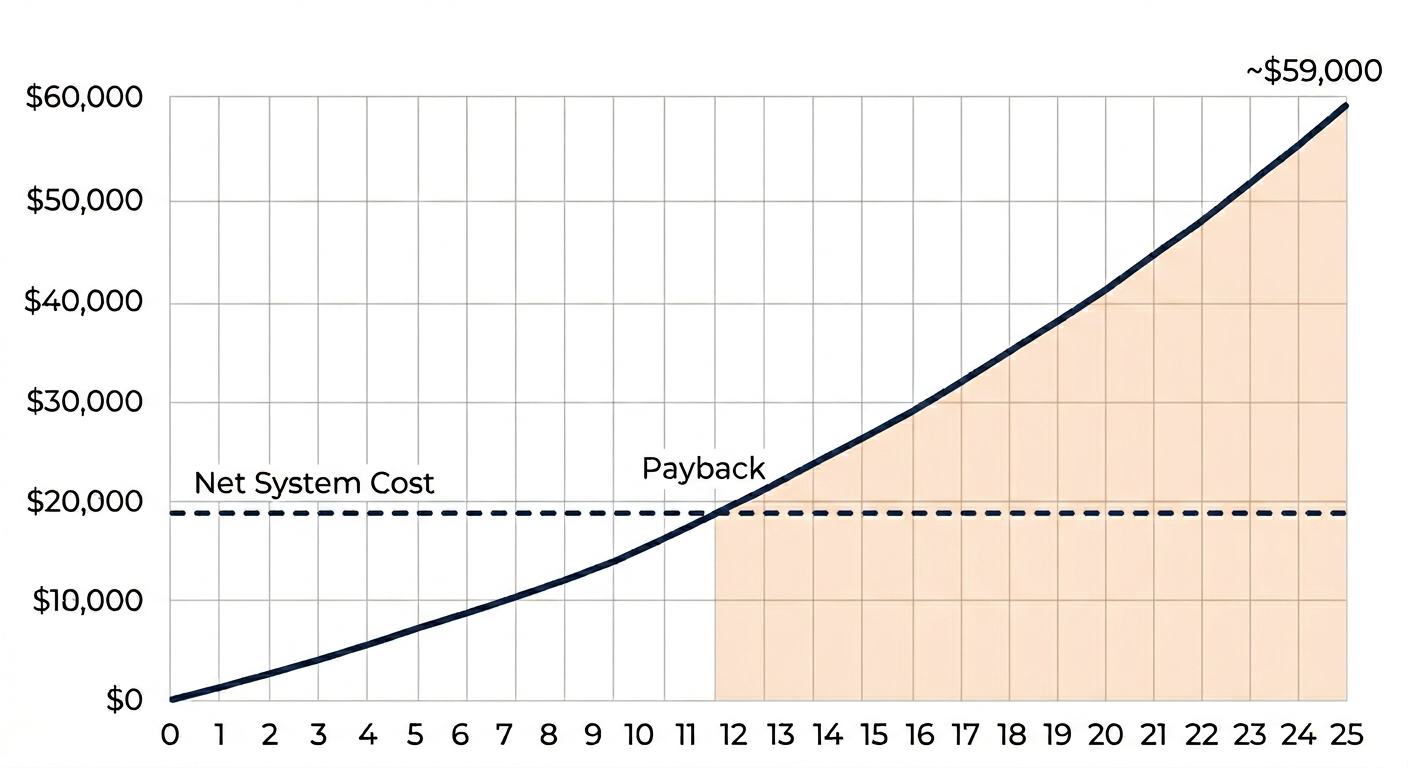
Cumulative electricity savings on a 9 kW system in the Twin Cities at 3% annual rate escalation. The $18,900 net system cost is recovered around year 12. Total 25-year savings: ~$59,000. Net benefit after system cost and inverter replacement: ~$38,000.
The inverter — which converts the panels' DC output to usable AC electricity — typically needs replacement once during the system's lifetime, at a cost of $1,000 to $2,500 installed. That cost belongs in any honest 25-year calculation.
Will solar increase my home's value?
National research from Lawrence Berkeley National Laboratory indicates solar panels add roughly $3 to $4 per watt of installed capacity to a home's sale price. For a 9 kW system, that translates to $27,000 to $36,000 in added value on paper. Minnesota's resale market for solar homes is less established than California, Arizona, or Colorado, where buyers are more accustomed to evaluating solar as part of a home purchase — so the actual premium is less predictable here.
One concrete and ongoing benefit: Minnesota's property tax exemption for solar energy systems means solar-added home value does not increase property taxes. This applies for the life of the system.
A homeowner planning to sell within five years should model the resale scenario carefully rather than assuming full recovery. The system adds value — how much a specific Minnesota buyer in a specific market will pay for it is less certain than in markets with higher adoption rates.
What does Xcel pay for excess electricity?
When solar panels produce more electricity than the home is using at that moment, the excess flows to the grid. Under Minnesota's net metering law, Xcel credits the homeowner approximately $0.11 to $0.13 per kWh for that excess — close to, but not always exactly equal to, the retail rate paid when drawing power. The practical result for a well-sized system is a monthly bill near zero, with the remaining balance being Xcel's fixed customer charge of roughly $11 to $12 per month.
Xcel does not write a check for surplus credits at year's end. If a system overproduces relative to annual consumption, the homeowner accumulates credits that may never be used. This is why sizing the system to match actual household usage — rather than oversizing it — matters. Net metering, Solar*Rewards, and Minnesota's tax exemptions interact to shape the full financial picture. The incentives page breaks down each one individually.
How does Minnesota's solar market compare?
Minnesota has fewer than 25,000 residential solar installations compared to over two million in California. But low adoption is not the same as poor viability. Minnesota's solar resource is sufficient, its incentive structure is solid, and its net metering law covers systems under 40 kW for all utilities. Minnesota has committed to 100% carbon-free electricity by 2040, and the legislative direction over the past decade has been consistently toward expanding solar access.
For homeowners considering solar now, the lower adoption rate means installer capacity is available without long wait times and incentive programs remain funded. Early adoption in a growing market is not a risk — it is simply where the timeline happens to be.
Frequently Asked Questions
Yes, but the system is smaller and the payback may be longer. A home with gas heat and gas water heating typically uses 400 to 600 kWh of electricity per month — significantly less than a home that heats with electricity. A smaller system has lower upfront cost but also lower annual savings. The financials still work; the payback period may be 12 to 15 years rather than 10 to 12. One scenario that changes this significantly: adding an electric vehicle or heat pump. Either one increases electricity consumption substantially, which improves the solar economics and may justify a larger system than your current usage alone would suggest.
If electricity rates stayed flat or declined, the payback period would lengthen. The calculations on this page use 3% annual escalation — a conservative assumption based on Xcel's historical rate increases of 3 to 4% annually. A scenario where rates stay flat would push the payback toward 14 to 16 years for a cash purchase, which still produces a positive return over 25 years. A scenario where rates dropped significantly would reduce the solar investment's returns but not eliminate them, since savings on electricity already used would still apply regardless of future rates. Given Minnesota's commitment to 100% carbon-free electricity by 2040 — which requires substantial grid investment — downward pressure on rates is the less likely scenario.
Yes. About 40% of Minnesota households are served by municipal utilities or electric cooperatives rather than Xcel. Minnesota's net metering law requires all utilities to provide net metering for residential systems under 40 kW, so the core mechanism applies broadly. However, the specific net metering credit rate, available incentive programs, and interconnection processes vary significantly by utility. Xcel's Solar*Rewards program is not available through other utilities — they may have their own incentive programs or none at all. If you are not an Xcel customer, contact your utility directly to understand their specific net metering terms and any available incentives before running the financial analysis.
It typically improves it. An electric vehicle adds 3,000 to 5,000 kWh per year in electricity consumption at typical Minnesota driving levels — equivalent to adding about a third of current household usage. A heat pump replacing gas heat can add 3,000 to 6,000 kWh per year depending on the home's heating load. Either one justifies a larger solar system, increases the annual electricity savings solar generates, and can improve the payback period compared to a smaller system sized only to current usage. A homeowner who is planning either addition in the next few years should factor that increased consumption into the system sizing conversation with the installer — not size to current usage and add capacity later.
Not sure if your home is a good solar candidate?
Answer 7 questions about your roof, electricity use, and situation. You'll get a specific assessment — including when the answer is not yet.
Take the Free Self-Assessment →